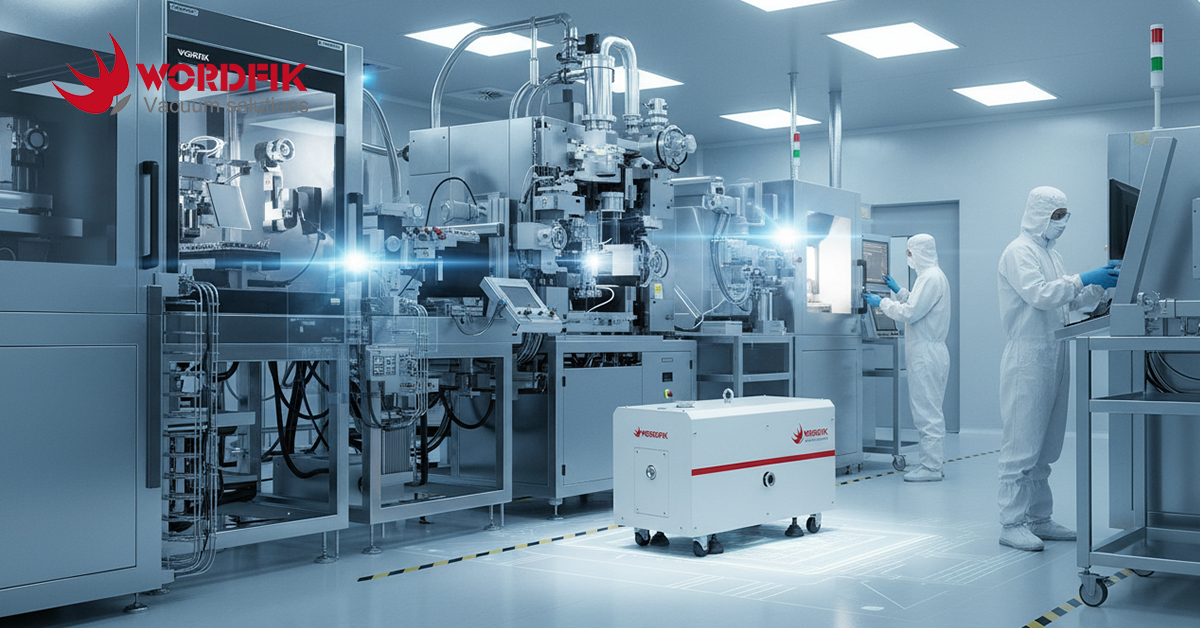
Screw Vacuum Pumps for Semiconductor Manufacturing
In the ultra-precise world of semiconductor manufacturing, vacuum systems are the unsung heroes. They create and maintain the pristine environments necessary for critical processes like chemical vapor deposition (CVD), etching, and ion implantation. However, when a vacuum pump fails or underperforms, it doesn't just cause a minor delay; it can lead to catastrophic yield loss, costly tool downtime, and contamination events that jeopardize entire production batches.
This guide details the five most common—and costly—vacuum pump problems in semiconductor fabrication plants (fabs). We'll explore their root causes, provide actionable solutions, and explain how selecting the right pump technology from the start is the most effective preventative strategy.
1. Hydrocarbon Contamination and Backstreaming
The Problem: This is the primary yield killer in front-end processes. Hydrocarbons from pump oils can backstream from the pump into the ultra-clean process chamber, contaminating wafers. These contaminants create defects in nanoscale circuits, leading to device failure and reduced yield.
Root Causes:
Using traditional oil-sealed rotary vane vacuum pumps or diffusion pumps in sensitive applications.
Pump oil degradation due to high temperatures or reaction with process gases.
Inadequate or malfunctioning purge systems and cold traps.
Solutions:
Eliminate the source: Transition to dry vacuum pump technology. Dry vacuum pumps, which use no sealing oil in the pumping chamber, completely remove the risk of hydrocarbon backstreaming.
Use point-of-use filtration: Implement and maintain effective inlet traps, adsorbers, or catalytic converters designed to capture specific contaminants.
Optimize maintenance: For processes where dry pumps are not yet feasible, implement an aggressive and frequent oil change schedule using only high-purity, semiconductor-grade fluids.
2. Corrosion and Chemical Attack
The Problem: Semiconductor processes use highly aggressive gases like fluorine, chlorine, boron trichloride, and tungsten hexafluoride. These gases and their plasma by-products can rapidly corrode a pump's internal components—such as rotors, stators, and bearings—leading to sudden failure, metallic particle generation, and unstable pumping performance.
Root Causes:
Standard pump materials (like standard steels or aluminum) are not compatible with process chemistries.
Insufficient or improper purge gas (like nitrogen) flow to sweep corrosive gases through the pump.
Moisture ingress, which can combine with process gases to form highly corrosive acids.
Solutions:
Specify corrosion-resistant construction: Choose pumps with nickel-plated, PTFE-coated, or ceramic-coated internals. For extreme applications, specify pumps made entirely of corrosion-resistant alloys.
Ensure proper dry purging: Implement a continuous, regulated inert gas purge system. This creates a protective barrier and helps transport reactive by-products through the pump before they can deposit or corrode.
Control moisture: Use load locks and ensure the pump and exhaust lines are properly heated to prevent condensation.
3. Particle Generation and Shedding
The Problem: The vacuum pump itself can become a source of particulate contamination. Particles can be generated from internal wear (e.g., bearing degradation) or from flakes of hardened process deposits breaking loose. These particles can migrate upstream, contaminating chambers and wafers.
Root Causes:
Mechanical wear in pumps with contacting components.
Buildup and subsequent flaking of process residues (e.g., oxides, nitrides) inside the pump.
Use of internal lubricants that can degrade and form particles.
Solutions:
Select pumps with non-contacting technology: Pumps like screw or claw pumps have synchronized rotors that never touch, drastically reducing wear-based particle generation.
Implement in-situ cleaning: Choose pump models that allow for automated Cleaning-In-Place (CIP) procedures. This safely dissolves and removes internal deposits without disassembly, keeping the pump clean and restoring performance.
Monitor pump exhaust: Install particle counters on pump exhaust lines to proactively monitor the pump's particulate output and schedule maintenance before it becomes a problem.
4. Poor Reliability and High Maintenance Downtime
The Problem: Unplanned pump failures cause unscheduled tool downtime, which is extraordinarily expensive in a high-utilization fab. Frequent, lengthy maintenance also reduces overall equipment effectiveness (OEE).
Root Causes:
Pumps not engineered for 24/7 semiconductor duty cycles.
Lack of condition monitoring leading to reactive (not proactive) maintenance.
Complex pump designs that are difficult and time-consuming to service.
Solutions:
Invest in robust, semiconductor-grade pumps: Choose pumps specifically designed and built for continuous operation in harsh fab environments, not repurposed industrial models.
Adopt predictive maintenance: Utilize pumps with integrated smart sensors that monitor temperature, vibration, and motor power. Advanced controllers can trend this data to predict failures weeks in advance.
Design for serviceability: Select pumps with a modular design that allows for quick replacement of high-wear components like bearings or seals, minimizing mean time to repair (MTTR).
5. Inefficient Energy Consumption
The Problem: Vacuum pumps are among the largest consumers of electricity in a fab. Older or inefficient pump designs run at a constant speed regardless of process demand, wasting massive amounts of energy and increasing the fab's carbon footprint and operating costs.
Root Causes:
Use of fixed-speed pumps with throttle valves or bypass lines.
Oversized pumps running far from their optimal efficiency point.
Lack of system-level energy management.
Solutions:
Implement variable frequency drive (VFD) technology: A VFD screw vacuum pump can adjust its speed precisely to match the real-time gas load. This can reduce energy consumption by 40-60% compared to a fixed-speed pump.
Right-size your pump: Work with application engineers to select a pump that operates near its peak efficiency for your specific process base pressure and flow requirements.
Consider heat recovery: The compression work in a pump generates heat. Advanced systems can capture this thermal energy for use elsewhere in the facility.
Why the Wordfik DVS Series Screw Vacuum Pumps is the Ideal Choice for Semiconductor Manufacturing
Addressing the five critical problems above requires more than just a standard pump; it demands a solution engineered for the semiconductor industry's unique challenges. The Wordfik DVS Series Oil-Free Screw Vacuum Pump is designed from the ground up to be this solution.
Ultimate Purity & Proactive Contamination Control: As a true 100% oil-free pump, the DVS Series eliminates the risk of hydrocarbon contamination at its source. Crucially, its integrated optimized nitrogen purge system allows for precise, continuous purging of the pumping chamber. This actively prevents the condensation and accumulation of corrosive or particulate-forming process by-products, safeguarding your yield in the most sensitive deposition and etch processes.
Unmatched Chemical Resistance: Engineered with advanced coatings and corrosion-resistant materials on all wetted surfaces, the DVS pump withstands the industry's most aggressive chemistries, ensuring long life and reliability.
Designed for Cleanliness: The non-contacting screw rotors minimize particle generation, while options for automated in-situ cleaning (CIP) prevent performance-degrading deposits from forming, maintaining a clean pumping environment.
Maximum Uptime with Smart Monitoring: Built for continuous duty with a robust design, the DVS pump offers more than just reliability. Its integrated IoT connectivity and smart sensors enable real-time, remote monitoring of critical health parameters such as bearing temperature, vibration, and motor load. This allows for true predictive maintenance, alerting your team to potential issues before they cause unplanned downtime, thereby maximizing your tool availability and Overall Equipment Effectiveness (OEE).
Intelligent Efficiency: Equipped with a high-efficiency Variable Frequency Drive (VFD), the DVS pump dynamically adjusts speed to process demand, delivering significant energy savings and a lower total cost of ownership.
In semiconductor manufacturing, your vacuum pump is a critical component of your process integrity. Choosing a pump like the Wordfik DVS Series that is purpose-built to solve these core industry problems is an investment in yield, uptime, and operational excellence.